



Reverse Engineering from 3D Scanning: A Lifeline for Machines That Lost Their Original Blueprints
A machine that’s been running for over a decade suddenly breaks down — one critical part fails. The original supplier stopped making it years ago, or doesn’t even exist anymore. The original CAD drawing, if it ever existed, has long been lost to time or buried on a hard drive that died ages ago. This is a situation far too common among manufacturing and mechanical engineering businesses in Vietnam. And reverse engineering from 3D scanning is quietly rescuing countless machines that would otherwise be forced into early retirement.
What Is Reverse Engineering from 3D Scanning?
Reverse engineering is the process of rebuilding a CAD drawing from a physical object — the opposite direction of the usual workflow, which goes from drawing to product. When combined with 3D scanning technology, this process becomes dramatically faster and more accurate than the traditional approach of manually measuring dimensions with calipers and protractors, then redrawing everything by hand.
With 3D scanning, the entire geometry of a part — including complex curves, angled surfaces, or internal features that are nearly impossible to measure by hand — gets digitized accurately into point cloud data, then converted into an editable, production-ready CAD drawing.
Why Do Businesses Need Reverse Engineering?
Legacy parts whose suppliers have discontinued production or no longer exist
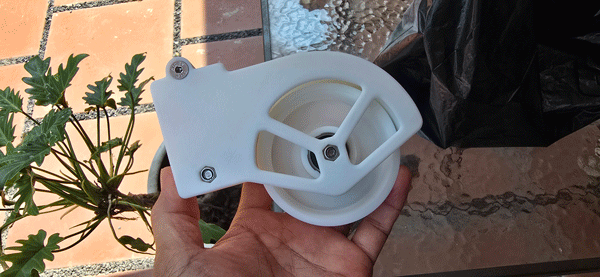
This is the most common scenario — imported machinery, specialized components, or long-standing equipment now need replacement parts that can no longer be ordered from the original manufacturer.
No original CAD drawing, or the drawing no longer matches reality
Many machines have been repaired and modified repeatedly over the years, leaving the actual geometry far different from the original design (if a drawing even survives). At that point, the old paper drawing is essentially useless.
Wanting to improve or optimize an existing design
Some businesses want to use an existing product as a starting point to improve the design, change materials, or optimize performance — which requires an accurate CAD foundation before any modifications can begin.
Proactive digitization to reduce future risk
Even without an immediate repair need, many factories proactively digitize critical or rare components so backup data is ready whenever it’s needed.
How Does the Reverse Engineering Process Work?
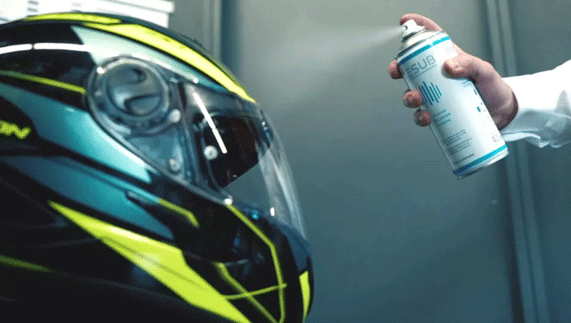
Step 1 — Surface preparation: For shiny, reflective, or dark-colored materials, the surface is treated with a specialized anti-glare spray so the scanner can capture accurate data.
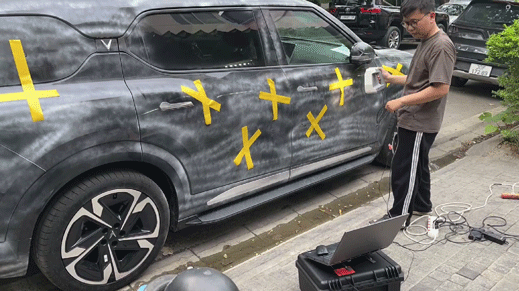
Step 2 — Applying positioning markers: Small reference markers are placed around the object so the software can accurately align data captured from multiple scanning angles.
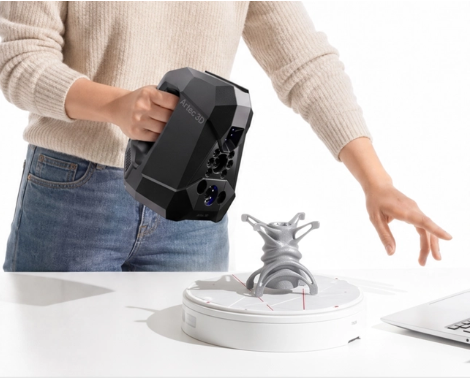
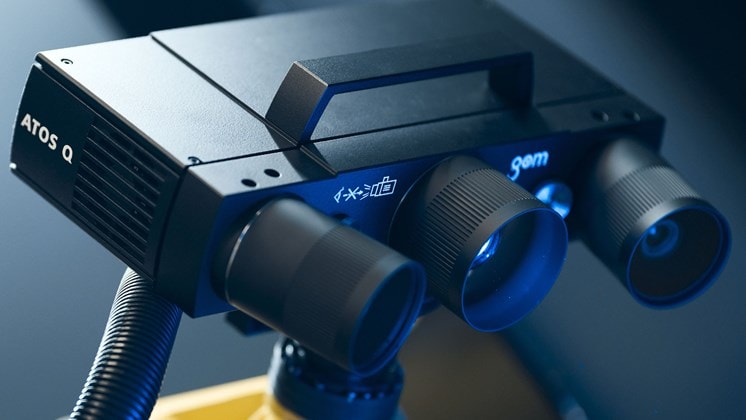
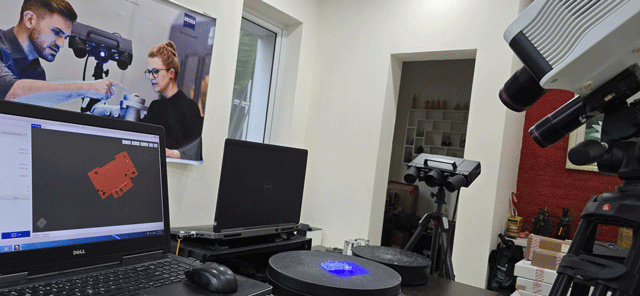
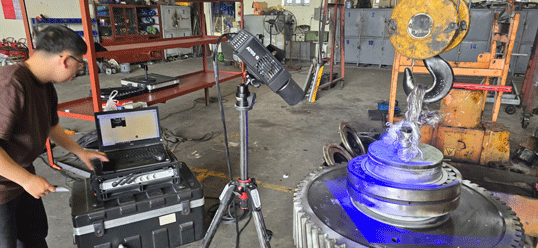
Step 3 — Scanning: A technician uses a 3D scanner (such as the ATOS Q) to capture the entire part from multiple angles — even on-site, if the part is too large or can’t be removed for transport.
Step 4 — Data processing and CAD reconstruction: The resulting point cloud data is processed, cleaned of noise, and converted into a complete CAD drawing — ready for manufacturing, reproduction, or archiving.
Real-World Applications
- Restoring discontinued mechanical components — gears, couplings, specialized housings
- Digitizing vehicle frames and platforms — as in Scantech’s on-site projects scanning electric motorbike chassis components and mechanical clamp/gripper parts
- Rebuilding CAD data for industrial molds worn down or damaged over time
- Improving product designs based on an existing physical sample, without starting from scratch
Why Choose a Provider with Real-World Experience?
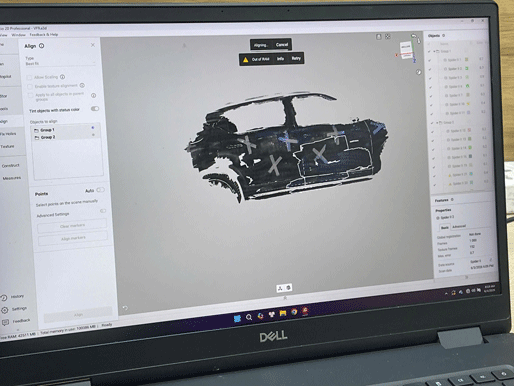
Reverse engineering isn’t just “scan it and export a file” — the accuracy of the final CAD drawing depends on both the equipment and the technical team’s experience processing the data. A small error during processing can result in a new drawing that doesn’t actually fit real-world assembly, wasting time and materials during re-manufacturing.
Scantech has directly carried out numerous 3D scanning projects for reverse engineering purposes on-site — from small mechanical components to large-scale frames and platforms — following a consistent process from surface preparation through to final CAD reconstruction.
Losing the original blueprint no longer has to mean the end for a machine or a valuable component. With reverse engineering from 3D scanning, businesses can “revive” lost technical data, gaining more control over repairs, improvements, and production — without depending on the original supplier.
👉 Contact Scantech for a reverse engineering from 3D scanning consultation:
📞 Hotline: 0904 985 139 / 0862 170 366
📧 Email: ktscantech@gmail.com
🌐 Website: https://scantechvn.com
📘 Fanpage: facebook.com/scantechvn
🏢 Address: m 2 Phúc Đức, Quốc Oai, Hanoi
.svg)
.svg)
.svg)
OTHER NEWS