



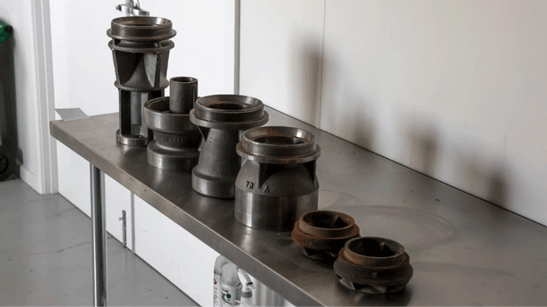
Reverse Engineering a Discontinued Pump Impeller with Artec Leo: From 3D Scan to Bronze Casting
Industrial pumps are built to last for decades. That is a strength, right up to the day a critical part fails. By then the manufacturer may have moved on to a new model, the original drawings are gone, and the official spare parts have run out. The operator is left choosing between shutting the equipment down and replacing the whole unit.
A recent reverse engineering project in Australia shows a third option: 3D scan the failed part, rebuild it as a CAD model, then cast and machine it with proven conventional methods. This article walks through that project, explains why the team chose this route instead of 3D printing, and highlights what manufacturers in Vietnam can take from it.
Background: Old Pumps, No Drawings
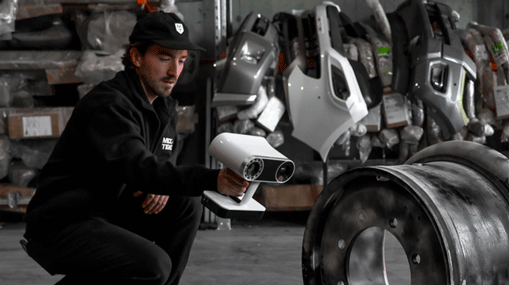
Condamine Drilling is a company in Queensland, Australia that provides drilling services, irrigation supplies and pump services. Like many businesses in these sectors, it relies on heavy-duty pumps that have been in service for years. For some components, the original engineering drawings had been lost, and the manufacturers could no longer supply replacements.
The company turned to Forma 3D, a 3D scanning service provider working across automotive, manufacturing, construction and other sectors. Forma 3D used an Artec Leo handheld scanner supplied by Artec’s reseller in Australia. The part to be digitized was the pump impeller, the rotating component that moves the fluid. Its shape largely determines how well the whole pump performs.
Why Reverse Engineer and Cast Instead of 3D Print?
The initial idea was to 3D print spare parts. After evaluating the option, the team concluded it was not suitable. Impellers work under pressure, in flowing fluid, and under constant wear. Given those demands, they chose a route with a long track record: rebuild the CAD drawings and manufacture the part by casting in bronze at a foundry, followed by machining and finishing.
This is a useful reminder for customers: 3D scanning is not the same as 3D printing. Scanning captures the geometry. The final manufacturing method, whether 3D printing, casting or CNC machining, should be chosen according to how the part actually works. If you are weighing these options, see also Scantech’s article on [reverse engineering from 3D scans for machines that have lost their original drawings].
Why Impellers Are Hard to Scan
Impellers challenge a 3D scanner in three ways:
- Complex geometry. Curved vanes, narrow gaps and deep passages are hard to capture completely if the scanner has to stay in one place.
- Reflective surfaces. Shiny metal reflects laser light unpredictably, which can cause noisy data or holes (a common cause of [3D scans that return no usable data]).
- Mid-range size. The parts are too large to fit comfortably in a desktop scanner, but a handheld scanner can capture them with only a few passes.
Measuring by hand and redrawing is slow and error-prone, and the internal vane profile is exactly what affects pump performance.
Why a Wireless Handheld Scanner Fits the Job
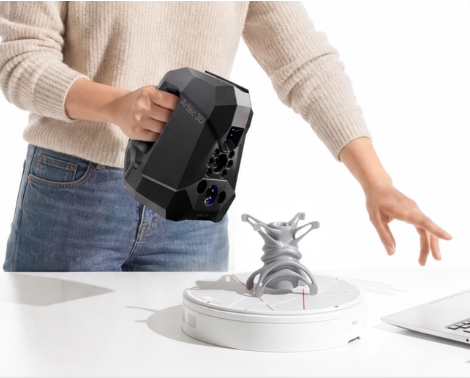
The team used Artec Leo, a wireless handheld scanner with a built-in computer, touchscreen and battery. It can work in a small workshop without being tethered to a laptop. According to the manufacturer, it captures around 35 million points per second and does not need lengthy setup or calibration before scanning.
Two practical advantages stood out in this project:
- Flexibility across sizes. Impellers of different sizes could be scanned by simply moving around each part, with no need to reconfigure equipment for every size.
- Real-time feedback. The screen shows which areas have been fully captured and which are still missing. In reverse engineering this matters, because gaps in complex geometry often only show up later during data processing.
Forma 3D technician Harry Tighe noted that Leo’s accuracy and resolution suited the size range of these impellers and that each part needed only a small number of scans. With multiple impellers to digitize, the workflow had to be efficient and repeatable.
The Workflow: From Scan Data to a Cast Part
The whole process can be summarized in four steps:
Step 1: 3D scan the part. Scan with Artec Leo from multiple angles, checking coverage on the screen as you go.
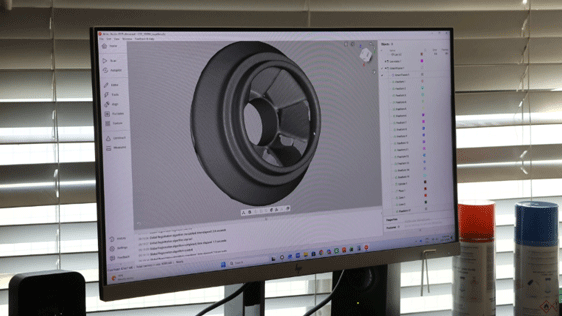
Step 2: Process the data in Artec Studio. The software aligns all scan frames into a single point cloud (Global Registration), then merges them into a watertight mesh (Sharp Fusion). The result is a detailed 3D model with every surface of the impeller.
Step 3: Rebuild the CAD model in SOLIDWORKS. Engineers turn the mesh into an editable CAD model suitable for manufacturing.
Step 4: Cast and machine. Condamine took the design to a foundry to cast the impellers in bronze. The castings were then machined, finished and returned to service.
Notably, the final model was accurate enough to hand directly to a supplier without further engineering work.
Results and Lasting Value
According to the project description, the replacement impellers have been put back into service. Before this approach, Condamine had essentially no way to replace the failed parts, so reverse engineering was the only viable route.
Beyond the physical parts, the customer now owns a digital asset: the 3D data of each impeller. The next time a part fails, they can send the dataset to a supplier instead of measuring and redrawing from scratch. This is the idea of a “digital spare parts warehouse.”
According to the team, the new workflow takes far less time than manual measurement and redrawing, and gives more confidence in dimensional accuracy. The original case study does not publish specific figures for time or cost savings, so we do not quote any here.
What This Means for Manufacturers in Vietnam
Condamine’s situation is not unique to pumps. The project team points out that countless ageing machines worldwide have lost their original drawings or no longer have a spare parts supply chain. Manufacturers in Vietnam with long-running equipment, for example in the following areas, may face similar situations:
- Irrigation, water supply and wastewater treatment
- Mining, cement and thermal power
- Food processing, paper and textiles
- Shipbuilding, agricultural machinery and construction equipment
Reverse engineering with 3D scanning is worth considering if you recognize any of these signs:
- The part is discontinued or the manufacturer no longer supports it
- The original drawings are lost, or the existing drawings no longer match the real part after repeated modifications
- The part has complex curved geometry that is hard to measure with calipers
- Downtime costs far more than making a new part
- You want a digital record for repeat orders in the future
Frequently Asked Questions
What is reverse engineering with 3D scanning? It is the process of digitizing a physical part with a 3D scanner and then rebuilding it as a CAD model, so the part can be edited, inspected or manufactured again when no original drawings exist.
Can shiny metal parts be scanned? Yes, but it takes the right technique and equipment, because reflective surfaces can distort the data. When needed, engineers can treat the surface or adjust the scanning approach.
Does scanning always lead to 3D printing? No. The manufacturing method depends on the working conditions of the part, such as pressure, temperature and wear. The part might be 3D printed, cast, CNC machined, or made with a combination of methods.
Is a handheld or a fixed scanner better? Parts of varying size, or work in a workshop or on site, usually suit a wireless handheld scanner. Very small parts that need very high accuracy may suit a desktop scanner.
Can the scan data be reused? Yes. That is a major advantage. The 3D data can be stored and used for repeat orders, design changes, or comparing wear after a period of operation.
How Scantech Can Help
Scantech Vietnam is an authorized reseller of Artec 3D, ZEISS and 3D Systems in Vietnam. We offer both equipment and services, including 3D scanning, reverse engineering, 3D design and 3D printing, at our showroom in Quoc Oai, Hanoi.
If your company has discontinued parts or machines with lost drawings:
- Need a fast solution with little investment: contact Scantech’s 3D scanning and reverse engineering services.
- Need to do this regularly: look at the Artec Leo and our other 3D scanners.
SCANTECH VN
📞 Hotline: 0904 985 139 – 0862 170 366
📧 Email: ktscantech@gmail.com
🌐 Website: scantechvn.com
📘 Fanpage: facebook.com/scantechvn
🏢 Address: Xom 2 Phuc Duc, Quoc Oai, Hanoi, Vietnam
.svg)
.svg)
.svg)
OTHER NEWS