




TPU 3D Printing: Properties, Pros, Cons & Applications
Not every part needs to be rigid. Some components need to be soft, flexible and elastic like rubber: sealing gaskets, shock-absorbing pads, protective covers that take impact. That’s where TPU shines. This guide explains what TPU is, when to choose it, and what to watch for when printing with it.
What Is TPU?
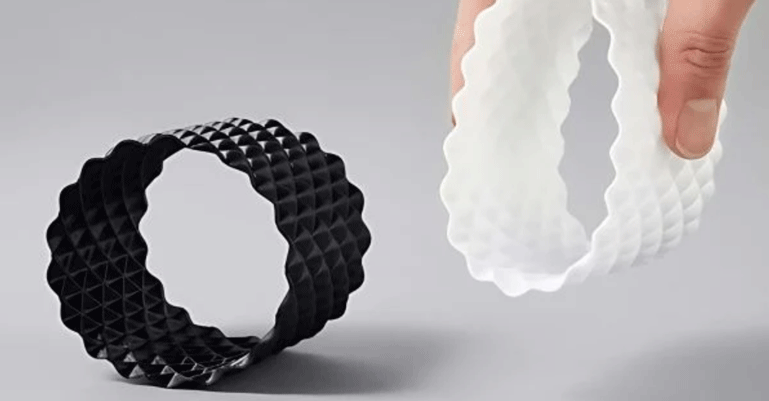
TPU (Thermoplastic Polyurethane) is a thermoplastic elastomer: a material that stretches, bends and returns to its original shape without breaking or permanently deforming. Unlike rigid plastics such as PLA or ABS, TPU behaves much like rubber, yet it can still be printed on a standard FDM filament printer with a few adjustments.
TPU hardness is measured on the Shore A scale. Common grades on the market sit around 85A–95A. The lower the number, the softer the material; the higher, the closer it gets to semi-rigid plastic. Manufacturers offer several hardness grades to match different needs.
Key Properties of 3D-Printed TPU
| Property | Description |
|---|---|
| Elasticity | Very high; bends and stretches, then returns to shape |
| Tensile strength | Good; resists tearing |
| Abrasion resistance | Good; holds up under continuous friction |
| Vibration damping | Good; absorbs shock and impact |
| Chemical / oil resistance | Fairly good (varies by grade) |
| Hardness (Shore A) | Typically 85A–95A; softer and harder grades exist |
| Print speed | Slower than rigid plastics; needs careful control |
Figures are approximate and vary by filament brand and print settings.
Advantages of 3D Printing with TPU

1. Rubber-like elasticity and flexibility
TPU bends, squeezes and stretches without cracking, something no rigid plastic can do. It suits parts that must fit snugly, wrap around surfaces or withstand repeated deformation.
2. Absorbs shock and dampens vibration
Thanks to its elasticity, TPU absorbs impact and vibration effectively. It is commonly used for anti-vibration feet, shock-absorbing pads and protective covers for equipment.
3. Wear-resistant under continuous friction
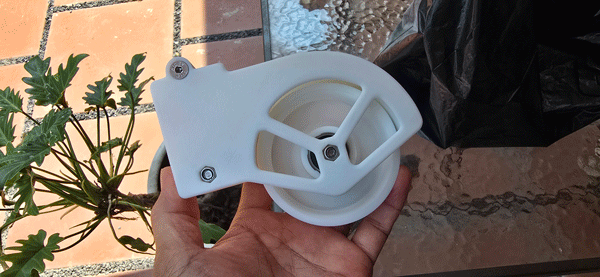
TPU tolerates friction better than many rigid plastics, making it a good fit for parts that rub constantly, such as small wheels, belts and washers.
4. Resistant to oils and some chemicals
Many TPU grades resist oils, lubricating grease and some mild solvents, which suits parts used in mechanical environments.
5. Stays tough at low temperatures
TPU is less prone to sudden stiffening or brittleness in the cold than many other plastics, so it works well for outdoor products or colder environments.
Drawbacks to Consider
- Slower to print than rigid plastics: soft material deforms when extruded too fast, so printing usually runs at lower speeds to keep quality consistent.
- Difficult for small, thin-walled features: flexible material makes delicate parts prone to vibration and layer misalignment during printing.
- Absorbs moisture easily: TPU takes in humidity from the air; poorly stored filament leads to bubbles and uneven surfaces.
- Not suited to parts needing rigidity or compressive strength: TPU cannot replace ABS or Nylon where parts must hold their shape under heavy load.
- Harder to glue and paint than rigid plastics: its elastic surface doesn’t bond with adhesives or paint as readily as ABS.
TPU vs. ABS vs. PLA
| Criteria | TPU | ABS | PLA |
|---|---|---|---|
| Elasticity | Very high (rubber-like) | None | None |
| Stiffness | Soft, flexible | Rigid, tough | Rigid, brittle |
| Vibration damping | Very good | Poor | Poor |
| Print speed | Slow | Moderate | Fast |
| Post-processing (glue, paint) | Difficult | Easy | Moderate |
In short: TPU doesn’t compete head-to-head with ABS or PLA. It’s the choice for parts that need to be flexible, where rigid materials simply can’t do the job.
Applications of TPU in 3D Printing
- Gaskets and seals: O-rings, waterproof and dustproof gaskets for equipment
- Protective covers: phone cases and shock-resistant covers for handheld machinery
- Anti-vibration feet and damping mounts: for machines and fixed equipment
- Belts and small friction rings: parts that need grip and wear resistance
- Medical and orthopedic parts: shoe insoles and orthotic inserts that must conform and flex
- Sports and protective gear: pads and contact areas that need to be soft yet durable
When Should You Choose TPU?
Choose TPU when your part:
- Needs to bend, compress or deform elastically during use
- Needs to absorb vibration or impact instead of resisting force rigidly
- Experiences constant friction and needs wear resistance
- Must conform to uneven surfaces or seal gaps
If the part needs rigidity, high compressive strength or a fixed shape, ABS or Nylon will be a better fit.
Frequently Asked Questions
Is TPU durable?
Yes. TPU resists wear and tearing, and keeps its elasticity through many bending cycles, as long as it isn’t used beyond the temperature or chemical limits of that specific grade.
Is TPU harder to print than other filaments?
Somewhat. It needs slower speeds and tighter control of extrusion to avoid deformation or filament jams during printing.
Is TPU water- and oil-resistant?
Most TPU grades handle water and some light oils well, but exact performance depends on the grade. Share the operating environment when ordering so the right material can be recommended.
Can TPU parts be glued or painted?
It’s harder than with rigid plastics. The elastic surface usually needs adhesives and paints formulated for flexible materials to bond properly.
What hardness options does TPU come in?
TPU is graded on the Shore A scale, commonly around 85A–95A. Softer grades feel more like rubber; harder grades behave closer to semi-rigid plastic.
I need a part that’s both soft and load-bearing. Should I use TPU?
Think carefully: TPU is elastic but doesn’t carry heavy compressive or tensile loads like rigid plastics. If a part must be flexible and load-bearing, discuss the specifics first so the right material or structural design can be recommended.
Conclusion
TPU is the right choice when a 3D-printed part needs elasticity, vibration damping and wear resistance that rigid materials like ABS or PLA can’t deliver. It’s trickier to print and demands good process control, but it opens the door to flexible, functional parts that conventional rigid printing can’t produce.
Contact
📩 Need TPU 3D printing or advice on the right material? Contact ScanTech VN for support.
SCANTECH VN
📞 Hotline: 0904 985 139 – 0862 170 366
📧 Email: ktscantech@gmail.com
🌐 Website: scantechvn.com
📘 Fanpage: facebook.com/scantechvn
🏢 Address: Xom 2 Phuc Duc, Quoc Oai, Hanoi, Vietnam
.svg)
.svg)
.svg)
OTHER NEWS