



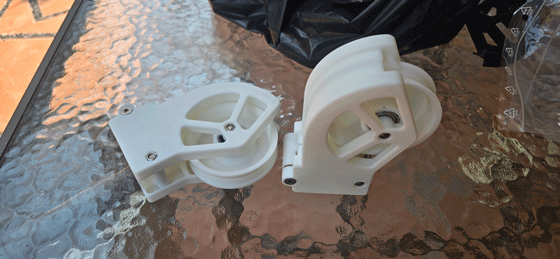
ABS 3D Printing: Properties, Pros, Cons & Applications
Among all 3D printing materials, ABS stands out for one thing: durability under real-world stress. It’s not by chance that ABS shows up in car interior trim, electronics enclosures, and snap-fit toys — it’s tough, impact-resistant, and holds up well under heat. This guide breaks down what ABS is, where it excels, where it falls short, and when it’s the right call for your part.
What Is ABS?
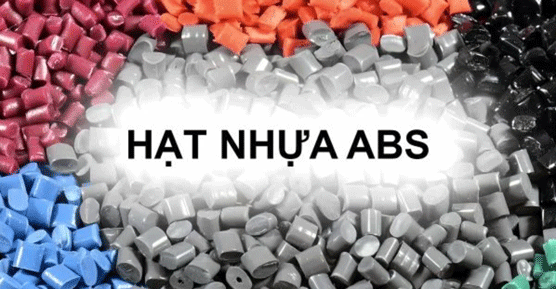
ABS (Acrylonitrile Butadiene Styrene) is an engineering-grade thermoplastic made of three components, each contributing a different property:
- Acrylonitrile — adds rigidity and chemical/heat resistance
- Butadiene — adds toughness and impact resistance
- Styrene — gives a glossy finish and makes the material easier to machine
Together, these give ABS a rare combination: rigid enough to hold shape, but tough enough to resist cracking — unlike PLA, which tends to shatter under sudden impact.
Key Properties of 3D-Printed ABS
| Property | Description |
|---|---|
| Impact resistance | High — withstands drops and sudden impacts well |
| Toughness | Deforms slightly before breaking rather than shattering |
| Heat resistance | Roughly 90–100°C, higher than PLA or PETG |
| Density | Lightweight (~1.04 g/cm³) |
| Post-processing | Easy to sand, drill, cut, glue, and paint |
| Print detail | Good — suitable for most technical parts |
Advantages of ABS 3D Printing
Strong impact resistance
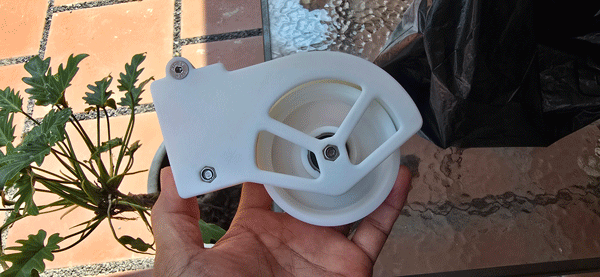
This is ABS’s biggest selling point. In a workshop stress test at ScanTech VN, an ABS-printed part was thrown directly onto a tiled floor and came away with no cracks or breaks — something a brittle material like PLA typically can’t survive.
Better heat resistance than PLA
ABS parts hold their shape at higher temperatures, making them a better fit for components placed inside vehicles, near heat sources, or used outdoors in hot climates.
Easy to finish after printing
ABS sands smoothly, bonds well with standard adhesives, and takes paint cleanly — allowing multi-part assemblies to be finished to a commercial-grade look.
Lightweight yet strong
ABS parts stay light while remaining rigid enough for enclosures, frames, and mechanical components.
Vapor smoothing available
ABS surfaces can be treated with solvent vapor to reduce visible layer lines, producing a smoother, glossier finish (requires proper technique and ventilation).
Drawbacks to Consider
- Prone to warping during printing: ABS shrinks as it cools, so large or wide-base parts can lift or curl at the edges without careful temperature control.
- Requires the right print setup: typically needs a heated bed and an enclosed chamber to maintain stable temperatures.
- Emits fumes while printing: proper ventilation is needed — one reason many people outsource ABS printing rather than doing it at home.
- Less eco-friendly than PLA: ABS is petroleum-based and not biodegradable.
- Less fine detail than resin: for small, highly detailed models needing an ultra-smooth surface, resin printing outperforms ABS.
ABS vs PLA vs PETG
| Criteria | ABS | PLA | PETG |
|---|---|---|---|
| Impact resistance | Excellent | Poor — brittle | Good |
| Heat resistance | Good | Low | Moderate |
| Print difficulty | Harder | Easy | Moderate |
| Post-processing (sand, glue, paint) | Very easy | Moderate | Harder |
| Best for | Functional parts, mechanical components, enclosures | Display models, prototypes | Everyday parts, moisture resistance |
Applications of ABS 3D Printing
- Mechanical parts & components: enclosures, brackets, covers, replacement parts requiring strength and impact resistance
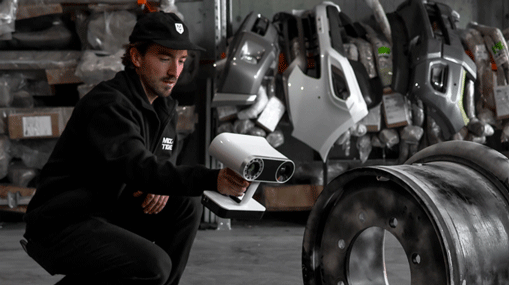
- Automotive accessories: trim pieces, custom parts, aftermarket accessories (often paired with 3D scanning to capture exact original dimensions)
- Electronics enclosures: parts requiring durability and ease of drilling/assembly
- Functional prototypes: testing fit, assembly, and load-bearing before mass production
- Display and technical models: multi-part assemblies that are painted for a finished look
- Jigs and fixtures: production and assembly aids used in workshops
When Should You Choose ABS?
Choose ABS when your part:
- May be dropped, impacted, or subjected to mechanical stress
- Needs better heat resistance than standard PLA
- Requires sanding, gluing, drilling, or painting after printing
- Is a functional component rather than a purely decorative one
If you only need an attractive display piece, PLA or resin may be a better and more economical fit.
From Idea to Finished ABS Part
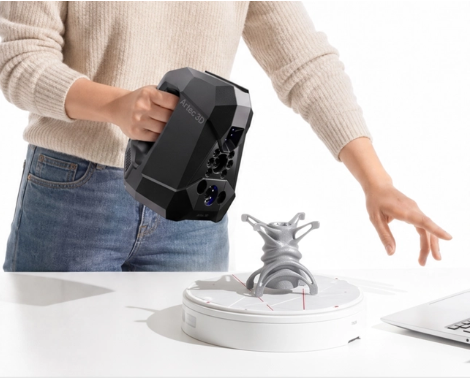
Provide a 3D file — either your own design file, or one captured via our 3D scanning service from an existing physical part.
File review and optimization — checking dimensions, tolerances, and print orientation for ABS.
3D printing in ABS.
Post-processing — support removal and surface cleanup.
Finishing (if needed) — assembly, bonding, and painting as required.
Delivery
Frequently Asked Questions
Is 3D-printed ABS durable?
Yes. ABS is known for its toughness and impact resistance, making it well suited for parts that experience mechanical stress or physical impact.
What temperature can ABS withstand?
Typically around 90–100°C, higher than PLA. The exact figure depends on the specific filament and usage conditions.
Can ABS-printed parts be painted?
Yes. ABS takes paint well after light sanding, making it a strong choice for models and parts that need a polished finish.
Can ABS parts be glued together?
Yes. ABS bonds well with standard adhesives, making it easy to assemble multiple printed parts into one finished piece.
Why outsource ABS printing instead of doing it yourself?
ABS requires tighter temperature control than PLA and produces fumes during printing. Using a professional printing service helps avoid warping issues and removes the need to invest in specialized equipment.
I only have a physical part, not a 3D file — what then?
You can use our 3D scanning service to capture the part as a digital file, then print or modify the design in ABS.
ABS is a strong choice when you need a 3D-printed part that’s durable, impact-resistant, heat-tolerant, and easy to finish after printing. While it’s more demanding to print than PLA, its strength and post-processing versatility make it a go-to material for mechanical components, replacement parts, and functional technical models.
SCANTECH VN
📞 Hotline: 0904 985 139 – 0862 170 366
📧 Email: ktscantech@gmail.com
🌐 Website: scantechvn.com
📘 Fanpage: facebook.com/scantechvn
🏢 Address: Xom 2 Phuc Duc, Quoc Oai, Hanoi, Vietnam
.svg)
.svg)
.svg)
OTHER NEWS